

Making History Visible: New Visions of Old New York at the Municipal Archives
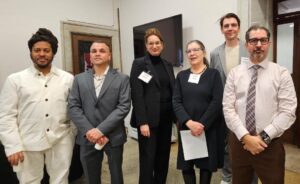
On December 11, 2025, the New York City Municipal Archives (DORIS) buzzed with conversation, curiosity, and discovery as a full house gathered for New Visions of Old New York: Making History Visible. Hosted by the Municipal Archives and the New Amsterdam History Center, this morning program marked the closing of a groundbreaking exhibition—and, fittingly, the opening of new collaborations reimagining how early New York’s history is shared with the public. The exhibit formed part of the larger Founded By NYC , the City’s year-long commemoration of its official founding as New Amsterdam 400 years earlier.
Far from the stereotype of dusty stacks, the Municipal Archives revealed itself as what NAHC’s Vanessa Sellers described as “the City’s living memory vault.” Within its walls, centuries-old maps, political records, and traces of daily life form an ever-evolving record of New York’s past—one now being reactivated through digital tools and inclusive historical perspectives. As its current director, Sellers pointed to NAHC’s Mapping Early New York Project—a digital platform uniting interactive maps, 3D models, and an Encyclopedia—as a contemporary research tool that uses spatial and visual analysis to offer an innovative, immersive way to experience history. Sellers pointed out that much of the Mapping vision originated with the project’s founder and former director, Toya Dubin, and that it continues through the ongoing contributions of Drew Shuptar-Rayvis, Jerry O’Toole, and Nitin Gadia, with special recognition of 3D modeler Eduard van Dijk in the Netherlands. She expressed thanks for this year’s energizing partnership with DORIS, as well as for the continued encouragement of NAHC’s cultural partners, Pauline Genee and Sietze Vermeulen at the Dutch Consulate.
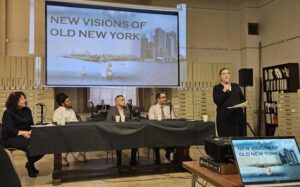
The lively panel discussion, moderated by Maria Iacullo-Bird, Assistant Provost for Research at Pace University, brought together Drew Shuptar-Rayvis, Algonkian historical consultant; Kamau Ware, artist and founder of the Black Gotham Experience; and Michael Lorenzini of the Department of Records and Information Services (DORIS). Their wide-ranging discussion emphasized the often overlooked but central roles of Indigenous peoples, enslaved and free Africans, and women in 17th-century New Amsterdam. Speakers urged audiences to practice “deep listening,” reminding us that Europeans arrived not on empty land, but into a complex Indigenous world of diplomacy, trade, and power—described pointedly by Drew Shuptar-Rayvis as “an active chess game.”
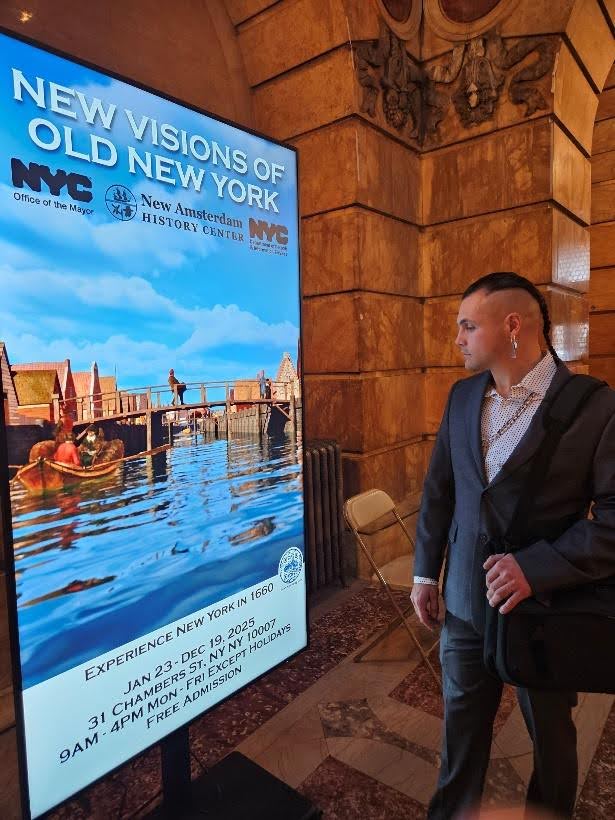 At the heart of the exhibition was the Mapping Early New York Project’s interactive touchscreen, with striking 3D models by Dutch modeler Eduard van Dijk. Here visitors eagerly explored the 1660 Castello Plan of New Amsterdam, zooming into Stuyvesant’s house, the Company Garden, the House of Enslaved People, the Wall, and other key sites. Additional 3D reconstructions—including the interior of Sara Kierstede’s home and the Indian Trading House—will debut this spring at New York Historical.
Extending beyond the archive walls, the project also reached citywide audiences through these links; The Canal , The Sunset, and The Ship. The video campaign developed with DORIS. Displayed on more than 2,000 screens at bus stops and subway entrances throughout the five boroughs, the short videos brought scenes of 17th-century New Amsterdam into everyday urban life, inviting New Yorkers to pause and consider the layered histories beneath their feet.
The closing program opened with remarks by DORIS Commissioner Pauline Toole and ended with reflections by Pauline Genee, Cultural Attaché at the Consulate General of the Kingdom of the Netherlands in New York, who underscored the importance of international and cross-cultural collaboration as New York approaches the close of its 400th anniversary commemorations. The coffee reception afterward encouraged continued conversation, with many participants remaining to connect with one another, while others took the opportunity to revisit the exhibition.
New Visions of Old New York affirmed what becomes possible when archival rigor, digital innovation, and inclusive storytelling come together. As the exhibition concluded, the message was clear: making history visible is not a finite project, but an ongoing, collective endeavor—one that continues to reshape how the City understands its past and its future. Looking ahead, the New Amsterdam History Center is excited and committed to sustaining this continued, shared effort.